Google AI Contribution pilot: paid for AI answers
Google is testing payments to sites whose content shapes answers in Gemini, AI Overviews and AI Mode. How it works and how to write pages AI relies on.

For two years, website owners have asked the same question about AI answers: if Google's AI uses my page to answer someone, what do I get? Google has started testing one answer. It's called the AI contribution pilot, and it pays a small group of sites, through Search Console, when their content shapes an answer in Gemini, AI Overviews or AI Mode.
Most sites won't be invited, at least not yet. But the rules of the pilot say a lot about what Google values in a page, and those rules apply to everyone who wants to be in AI answers at all.
What the AI contribution pilot is
Digiday reported the program on September 14, 2026, and Google confirmed it was an early-stage pilot. Google described it as a test of how to reward high-quality content on top of the traffic and tools it already provides.
It covers three products: the Gemini app, AI Overviews and AI Mode. That's one more than Search Console's generative AI report, which only counts AI Overviews and AI Mode.
It is invite-only. Digiday's sources said at least dozens of publishers had been approached, and the total wasn't confirmed. There's no public sign-up page.
The pilot sits beside another program. In its October 15 search update, Google said more than 400 publications now take part in its News AI pilot, a licensing deal where Google pays for enhanced news content. The contribution pilot is different: it runs inside Search Console and reaches beyond news sites.
What Google pays for, and what it doesn't
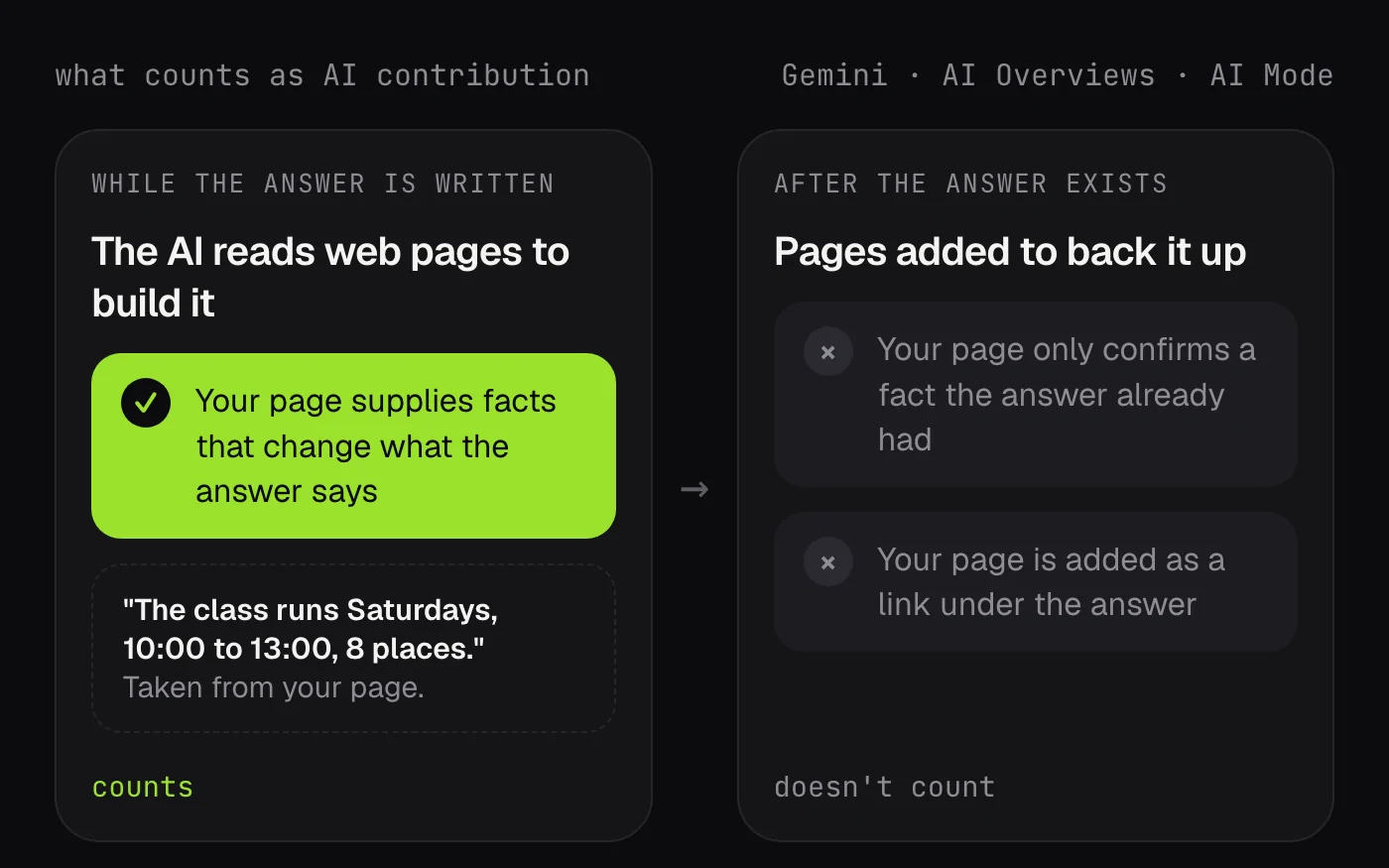
This is the part worth reading twice. According to help text in screenshots Digiday published, the pilot pays when content "contributes significantly" to an AI answer, and draws the line at the moment the answer is being written.
In Google's words: "Web content may also confirm facts or be linked to within Google's AI after a response is generated, but those instances don't qualify for AI contribution."
So a citation link isn't what earns. Neither is a page that only agrees with what the AI already said. What counts is a page that changes the answer: the source Google's AI read while putting the response together, and which shaped what it ended up saying.
That matches what Google said in June, when it described piloting a new way to partner with sites whose content adds to the "freshness and factuality" of AI answers through grounding. Grounding is the step where the AI looks up current web pages to base its answer on.
How it works inside Search Console
Once a publisher accepts the program's terms, a new panel for AI contributions appears in Search Console. It shows a monthly earnings figure and some history.
Earnings and payments are tracked separately, and the payment sent can differ from the earnings shown because of tax deductions or local payment thresholds. A site can leave the pilot at any time from Search Console's settings.
What the panel doesn't show is how the number was worked out. "It's quite black box," one executive who knows the program told Digiday. Another source called the early returns "peanuts" next to ad revenue.
The concerns publishers raise
Not everyone in publishing welcomes it. One executive pointed out that accepting the pilot could weaken a publisher's hand in pushing for better terms, since Google could point to it as payment already made. Luke Stillman of Madison and Wall told Digiday that programs like this can add some upside for publishers while helping Google reduce legal and reputational risk around how it uses content.
Two executives inside the pilot saw it differently: basic for now, but better than waiting for referral traffic to come back.
If you're invited, read the terms closely and compare the monthly figure with what the same pages earn you in other ways.
What it means if you're not a publisher
Most businesses reading this sell something other than articles. The pilot still matters, because it spells out what Google's AI treats as valuable: pages that supply facts the answer depends on. The same pages are the ones that get named, quoted and linked in AI answers today, paid or not.
Think about which questions only you can answer well. A bakery's opening hours and Saturday menu. A software company's real limits and integrations. A clinic's prices and how booking works. A shop's sizes, materials and delivery times. When an AI answer needs those facts, the best source is the business itself, as long as the business has written them down clearly.
An example: two pages, one question
Imagine someone asks an AI assistant how much a sourdough baking class costs in their town, and how long it takes. Two local bakeries have pages about their classes. (Both are made up, to show the difference.)
The first page says the bakery runs "fun, hands-on workshops for all levels" and invites you to get in touch for details. It's friendly. It also contains nothing an AI can use. The answer gets written without it, and at best the page is linked as one of several options.
The second page says, in its first two lines: "Our sourdough class runs every Saturday from 10:00 to 13:00. It costs 65 per person, includes a starter to take home, and has 8 places." Below that, a small table lists the dates for the next two months. An AI building the answer can take the time, the price and the group size straight from it. That page shapes the answer. Under the pilot's rules, that's the kind of page that would count.
Nothing about the second page is clever. It just says the facts first, in full sentences, and keeps them current.
How to write pages that shape AI answers
- Publish what only you know. First-hand numbers, prices, specs, local details, results from your own customers. A page that repeats what ten other sites say gives an AI nothing new to use.
- State facts plainly and in one place. One sentence that says what something costs, how long it takes or who it's for is easier to use than the same fact spread over a paragraph.
- Use tables for things people compare: plans, sizes, timings, ingredients. Give units and dates.
- Keep it fresh. Put a visible "updated" date on pages whose facts change, and change it when they do. Google named freshness as one of the two things it wants from sources.
- Back claims with something checkable: your own data, a named source, a real example. Factuality was the other.
- Mark up what you can with structured data, such as products, prices, opening hours, events and FAQs, so the facts are machine-readable as well as human-readable.
- Watch Search Console's generative AI report every month. Impressions there tell you which pages AI features already show.
What to watch next
Three things will tell you whether this pilot grows into something that matters for your site.
First, whether invitations reach more sites, and whether smaller businesses are among them. So far, reporting has focused on publishers. Second, whether Google publishes terms and explains how earnings are worked out, since a payment nobody can check is hard to plan around. Third, whether Search Console starts showing clicks from AI features, not just impressions. Payments and clicks together would finally give site owners a full picture of what AI answers are worth to them.
How QuQi helps
You can't improve what you can't see, and AI answers are hard to see from your own analytics. QuQi's AI Visibility teammate checks every week whether Google's AI Overview, ChatGPT, Perplexity and Gemini name you for the questions your buyers ask, and who they name instead. Each gap it finds becomes a brief for the Copywriter, who researches the topic and writes an article in your voice built to fill it.
For more on how AI answers pick their sources, read our guide to GEO, and for this month's other big change in Google's AI answers, see what the AI Mode links update means for your site.
Questions people ask
Can I apply for Google's AI contribution pilot?
Not as far as anyone has reported. It's invite-only, and Google hasn't published a sign-up page or public terms. Publishers in the pilot were approached, and the earnings panel appears in Search Console once they accept.
Does Google pay when it links to my site in an AI answer?
No. According to the pilot's help text, being linked or confirming a fact after the answer is written doesn't qualify. The pilot pays for content that shaped the answer while it was being generated.
How much does it pay?
Google hasn't said, and the panel doesn't explain how earnings are calculated. Early participants described the amounts as small next to their ad revenue.
Is this the same as Google's news licensing deals?
No. The News AI pilot is a licensing program with more than 400 news publications, where Google pays for enhanced content. The contribution pilot runs through Search Console and has reached sites beyond news.