Can Claude make videos and images? How QuQi does it
Claude has no image or video model of its own. Give it a computer with a browser and ffmpeg, though, and it makes both. Here is how QuQi does it.

The short answer is: not by itself. Claude is a language model. It writes, reasons and writes code, and in a conversation it can sketch diagrams and charts in HTML and SVG. It doesn't paint photos the way an image model does, and it has no button that turns a prompt into an MP4.
The longer answer is more interesting. Give Claude a computer and the situation changes. With a browser, a shell and ffmpeg, it can design a picture as a web page and save it as an image. It can animate that page frame by frame and encode the frames as a video. And for the few things code can't draw, like a human voice or a realistic photo, it can ask for help from models built for exactly that.
That's how QuQi now makes every video, picture and carousel for its customers. This article opens the hood: what the computer is, what Claude does on it, and why the results look like a designer's work rather than a one-shot generator's.
What a model alone can do, and what a computer adds
The difference is easiest to see side by side.
| The job | A language model on its own | Claude with its own machine |
|---|---|---|
| Write the script and storyboard | Yes | Yes |
| Design a picture with real type | As code someone else has to render | Renders it to an image itself |
| Use your fonts and logo | Only if you paste them in | Opens your website and takes them |
| Make an MP4 | No | Draws frames in a browser and encodes them with ffmpeg |
| Voice, music, a realistic photo | No | Orders them from specialist models, through QuQi |
| Check its own work | Rereads what it wrote | Measures every box on the page at the final size |
Everything in the right-hand column depends on one thing: a real computer the model can work on.
The missing piece is a computer
QuQi runs Claude through Boxline, a service that gives an AI agent an isolated machine in the cloud with a browser, a shell and a disk. Each piece is made on a clean machine of its own, so nothing from one customer's work ever sits beside another's.
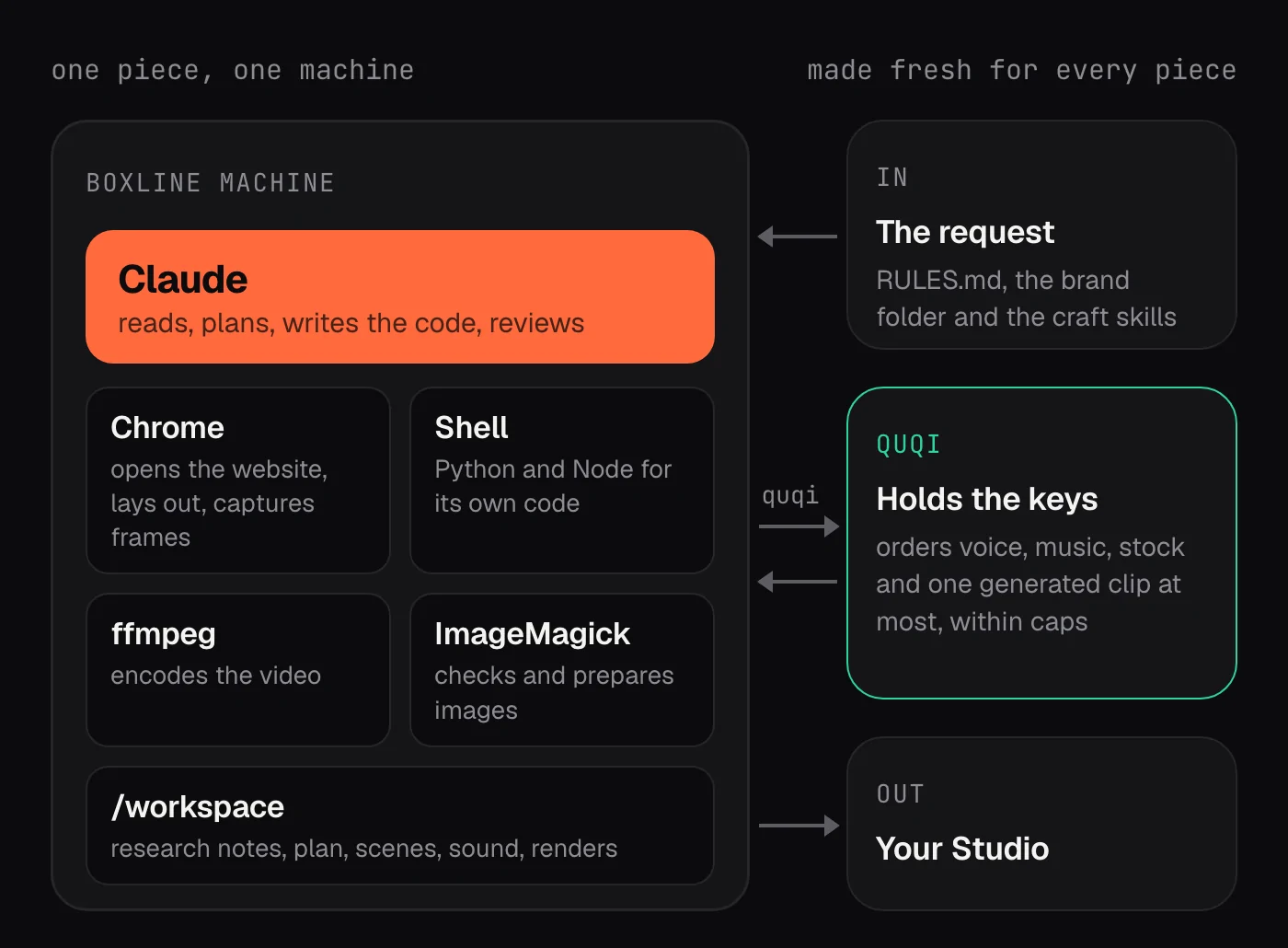
On the machine are the tools a motion designer's laptop would have, minus the mouse:
- Chrome, which Claude drives directly to open websites, lay out designs and capture frames. It can even run simple 3D scenes for a product shot.
- A shell with Python and Node, for writing and running its own code.
- ffmpeg to encode video, and ImageMagick to inspect and prepare images.
- A workspace disk where every file of the piece lives: research notes, the plan, scenes, sound and renders.
What the machine never holds is a key to anything. When Claude needs a voice, a music bed, a stock clip or a generated shot, it asks QuQi through a small command-line tool, and QuQi places the order with its own accounts. Every piece has caps on what it can order, so the agent can't spend more than a piece allows.
What's waiting on the machine when it starts
Before Claude begins, QuQi puts four things on the disk.
- RULES.md, the house rules. It opens with the business, with its context and brand kit written in, and then sets out what the customer needs and their instructions. Claude has to read it before it can order anything.
- A brand folder with the business profile, the logo and screenshots of the website.
- A library of craft skills: written guides to film and design technique, covering product films, motion b-roll, explainers, short-ad structures and sound, plus one on reviewing a piece before it renders.
- The
quqicommand, its only line to the outside. It reads the rules, answers questions about the business, lists the shop's products, takes the plan, orders assets, measures the scenes and checks the finished file.
Notice what's not on the list. QuQi passes no ready-made pieces: no templates, no kits, no sound files, no pictures chosen in advance. Everything in the final piece is picked or made for that one request.
A run, step by step
Say a shop asks for a short video about its spring sale. Here's the path Claude takes from the request to the finished file.
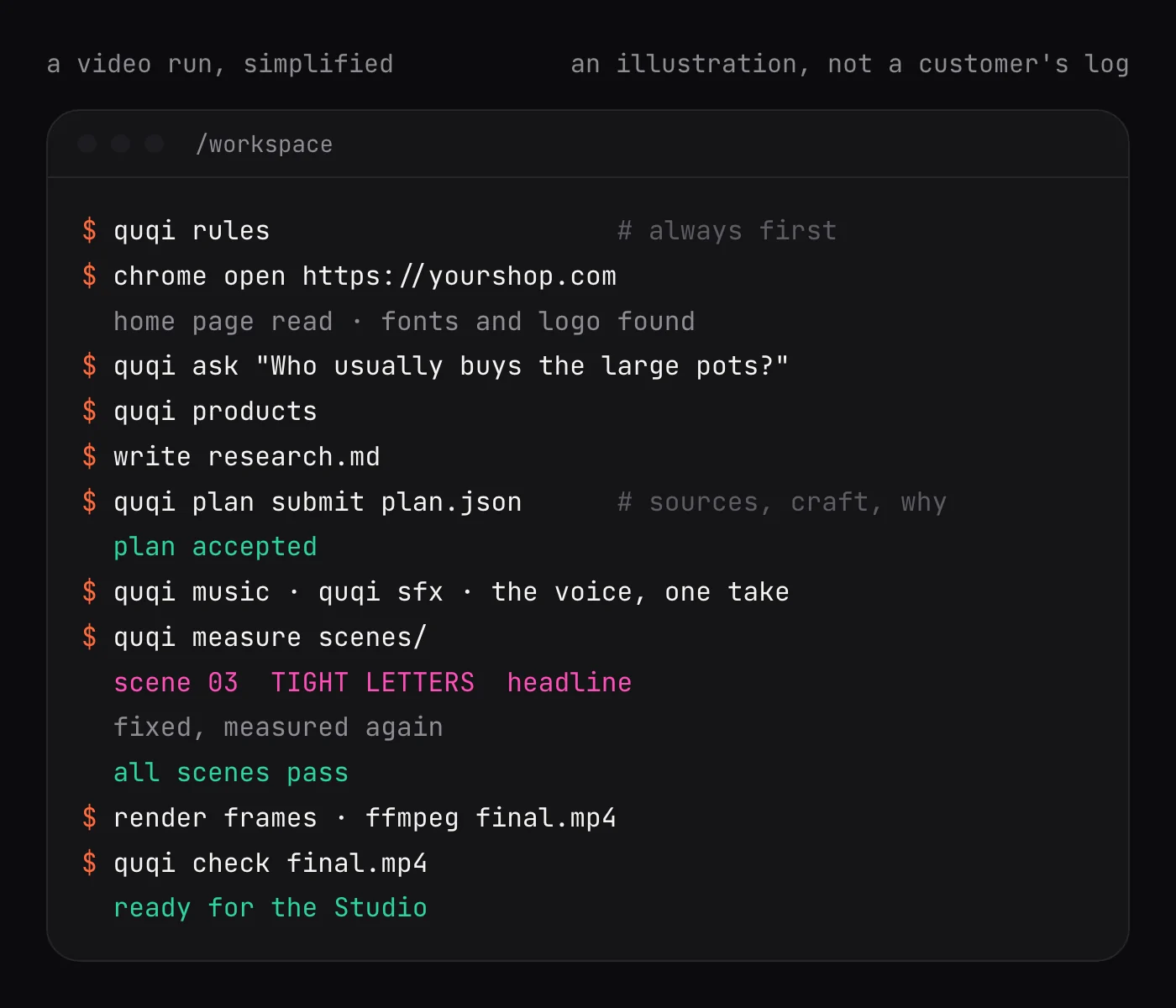
- Read the rules. The first command is
quqi rules. Nothing can be ordered before it. - Research. Claude opens the shop's home page in Chrome and any page the request names, reads the business profile, lists the products from the store and may ask QuQi up to 12 questions about the business. It writes what it learned into a research file. No research file, no orders.
- Choose the craft. It opens at least three craft guides for a video (two for a picture or carousel), and the guide to reviewing its work.
- Plan. It writes a plan that names, for every scene, where the picture comes from (the website, stock, a generated clip or its own code) and why. The plan also lists the techniques chosen, explains why they fit this business, and says how the piece will differ from the brand's last three. QuQi checks the plan and sends it back if, for example, Claude never actually opened the website.
- Build. Each scene is an HTML page with a function that can draw any moment of it. The text is set in the brand's own fonts, and product photos are cut out by QuQi so they sit cleanly on the design.
- Sound. One voice take, one music bed and a set of sound effects that Claude cuts and places itself. Captions are timed from the voice's word timings, and if a presenter speaks, the lips are synced only for the seconds on camera.
- Measure.
quqi measureopens every scene in Chrome at the final size and reports type that's too small, letters that touch, cramped lines, words outside the safe area, a logo too small to read and anything stretched or clipped. Claude fixes what it flags. - Render. It steps through each scene frame by frame and ffmpeg encodes the result once, at the settings the platforms want: H.264 video at 30 frames a second with AAC sound.
- Check and deliver.
quqi checkruns on the finished video, then QuQi runs its own checks and puts the piece in the customer's Studio.
A picture follows the same path without the sound and the frames: Claude designs it as a page, measures it and saves it as a PNG. A carousel does the same for each slide.
Why the design is a web page
It would be quicker to ask an image model for "an Instagram post about a spring sale". So why take the long way round? Because a browser is the most accurate typesetter most of us will ever own, and building on it brings four things a one-shot generator can't promise.
- Real type. The words are text, not a painting of text, so they're spelled right and set in the brand's own font.
- Measurable design. A browser knows the exact position and size of every box on the page. That's what makes an automatic design check possible at all.
- Repeatable frames. The same moment of a scene always draws the same way, so a fix can re-render only its own seconds instead of the whole film.
- Edits, not reruns. Changing a word changes a word. Nothing else on the page moves unless it should.
Generated media still has a place, but a small one. A picture or carousel gets one generated photo at most, and only a realistic one. A video gets one generated clip at most, never a generated still shown on screen, and stock is kept to about a third of the footage. The rest is Claude's own animation.
Rules carry more weight than prompts
An agent with a computer can do a lot, which is why the rules matter more than any one request. A few of them apply to every piece QuQi makes:
- The brand's colours, fonts and logo win over whatever style a request names.
- No famous people, no lookalikes and no other brand's logo.
- No strangers from stock passed off as the business's own people.
- Claims are copied word for word from the business, qualifiers included.
- The closing card is the logo with the website under it, and nothing else.
- In a vertical video, no words in the top tenth or the bottom fifth of the frame, where the apps put their own buttons.
One small rule we're fond of: every voice says QuQi as "Q-Kee", and every written word still spells it QuQi.
Who checks the work
There's no second AI marking the first one's homework. Claude is its own reviewer, and it reviews with numbers. The type rules are specific: no more than four sizes, each at least a quarter larger than the next, headlines never tracked tighter than 2 percent, and line spacing within set ranges for headlines and for body text.
Then QuQi checks the result from the outside. A piece goes back once if its review shows no measurements, if a video's length is off the brief, if the picture runs past the voice, or if a transcriber hears fewer than half of the spoken words.
Three quality levels, all on Claude
Customers choose between Standard, Normal and High quality. All three run on Claude. What changes between them is how much care goes into design, filming and review: Standard is quicker and costs less, and High quality is the most careful, for the pieces that matter most. Pictures and carousels start on High quality and videos on Normal. Every run works with Claude's reasoning turned up high.
Edits happen on the same machine
When a piece is delivered, its machine isn't thrown away. It's stopped and kept for two days, with every file on it, and each delivered edit adds two more days. Ask for a change and Claude picks up where it left off. If only the sound changes, the new sound is mixed over the picture already rendered, with no new frames. If one scene changes, only its seconds are rebuilt. The customer pays only for what changed.
How the pictures in this article were made
We used the same idea for this page. The cover, the diagram of the machine and the run above all began as HTML files, which we opened in headless Chrome and saved as images. No image model was involved, which is why every label in them is spelled right. Our other articles on AI video for social media and on-brand pictures and carousels were illustrated the same way.
Questions people ask
Can Claude generate images?
Not as pixels from a prompt, the way an image model does. It can write the HTML, SVG or code that draws an image, and with a browser on a machine it can render that code into a real image file. That's how QuQi makes pictures and carousels.
Can Claude make videos?
Not on its own, since it has no video model. With a computer it can: it builds each scene as an animated web page, captures the frames in a browser and encodes them with ffmpeg. Specialist models fill in the voice, the music and, at most, one generated clip.
What is Boxline?
Boxline is a service that gives AI agents their own isolated cloud machines, each with a browser, a shell and a disk. QuQi uses it so every piece gets a clean machine of its own, kept for two days afterwards for edits.
Do I need a Claude or Boxline account to use this?
No. QuQi runs all of it for you. You ask for a video, a picture or a carousel in the Studio or in a chat, and you pay in QuQi credits for what the piece actually uses.